Drainage Contractor in Cherokee County, GA: Fixing Water Problems Before They Get Expensive
The Short Version
If you own property in Cherokee County, you already know the pattern: a hard Georgia rain, and suddenly there's standing water where it doesn't belong - against the foundation, across the driveway, or pooling in the yard for days afterward. Most of these problems share one root cause. Cherokee County sits on dense red clay over rolling terrain, and clay does not absorb water - it sheds it. If the ground around your home or building wasn't shaped to send that water somewhere safe, the water picks its own path. That path is usually toward whatever you paid the most money for. A drainage contractor's job is to re-engineer how water moves across your property before it becomes a foundation repair, a failed septic system, or a washed-out driveway. This guide covers what drainage work actually involves, the warning signs Cherokee County property owners see most, and when the fix is a simple swale versus something bigger.
What a Drainage Contractor Actually Does
Drainage work is not landscaping, and it's more than digging a trench. A drainage contractor evaluates how water enters your property, where it concentrates, and where it should exit - then reshapes the ground to make that happen.
In practice, that means a mix of:
- Regrading: Reshaping slopes so surface water flows away from structures instead of toward them. This is the fix for the majority of residential water problems we see.
- Swales and ditches: Shallow channels cut to intercept runoff and carry it to a safe discharge point.
- Culverts: Pipes installed under driveways and road crossings so water can pass without washing out the surface above it.
- French drains and catch basins: Subsurface collection for water that can't be moved on the surface - common around foundations and low spots.
- Downspout and outlet management: Getting roof water piped far enough from the house that it can't cycle back against the foundation.
The right fix depends on where the water comes from, how much of it there is, and what's in its way. That diagnosis is most of what you're paying a drainage contractor for - the equipment work after it is straightforward by comparison.
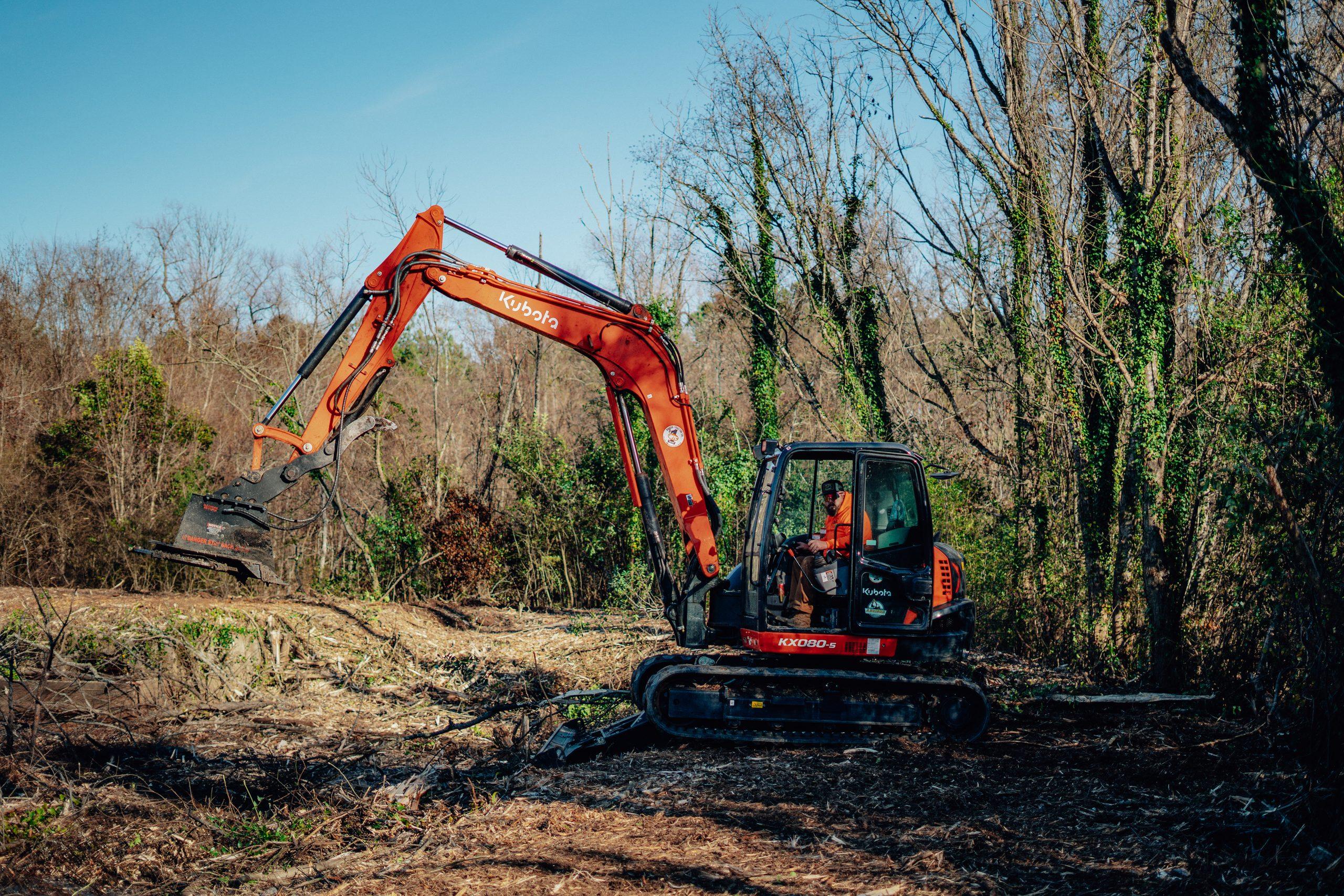
Why Cherokee County Properties Struggle with Drainage
Cherokee County has grown fast, and rapid development creates a specific drainage pattern: wooded hillsides get cleared, red clay subsoil gets compacted by construction, and runoff volumes increase while absorption drops to almost nothing.
The result shows up in a few predictable ways around Canton, Woodstock, Ball Ground, and Holly Springs:
- Newer subdivisions where lot-by-lot grading meets code minimums but doesn't account for how water behaves across the whole street.
- Acreage properties where a long driveway crosses natural drainage paths without culverts - every big storm eats another section of gravel.
- Sloped lots where the uphill neighbor's runoff arrives as sheet flow across the downhill yard.
- Creek-adjacent parcels where the water table sits high enough that surface fixes alone won't dry out a basement or crawl space.
None of these are exotic problems. They're the same four problems, repeated across thousands of Cherokee County lots, because the underlying soil and slope conditions are the same.
Warning Signs Your Property Needs Drainage Work
Drainage problems announce themselves early if you know what to look for. The cheap fix exists while the signs are small - they get expensive when ignored:
- Standing water that lingers more than 24-48 hours after a rain event, especially near the foundation or in the same spot every time.
- Mulch, gravel, or topsoil migrating downhill - visible proof that surface flow has enough volume and velocity to move material.
- Erosion channels or rills forming in the yard, along the driveway edges, or at the base of slopes.
- A damp or musty crawl space or basement, even without visible standing water inside.
- Silt or sediment deposits on the driveway, sidewalk, or patio after storms.
- Septic drainfield saturation - soggy ground over the field lines is both a drainage failure and a health department problem.
If two or more of these show up on the same property, the issue is usually systemic - the site's overall drainage design was never right, and spot fixes will just move the water to the next problem area.
The Fixes That Actually Work - and the Ones That Don't
The most common mistake we see is treating a surface-water problem with a surface patch. A load of topsoil dumped in a low spot, a short section of corrugated pipe - these move water a few feet and hand the problem to next month's storm.
Fixes that hold up in Cherokee County soil conditions follow a different rule: give the water a dedicated, engineered path all the way to a legal discharge point. That usually means:
- Regrading first, pipe second. If the surface can be shaped to carry water, that's cheaper and more durable than buried pipe. Pipe is for the volume that grading alone can't move.
- Correct pipe sizing and bedding. Undersized culverts and unbedded pipe are why so many Cherokee County driveways wash out. The pipe needs stone bedding, proper cover depth, and an outlet that doesn't erode.
- Discharging to a real outlet. Water has to go somewhere legal - a ditch, a drainage easement, a storm system. Pushing it onto a neighbor's lot isn't a fix; it's a dispute.
For properties where drainage work is part of a larger project - a new build, a pond, a driveway replacement - the drainage plan should be settled before the other work starts. Our grading services routinely include drainage correction as part of site preparation, because fixing it after the build costs several times more.
Drainage Work Across Cherokee County
Addison Excavations is based in Murrayville and works throughout Cherokee County and the surrounding North Georgia communities - Canton, Woodstock, Ball Ground, Holly Springs, Waleska, and the acreage properties between them.
Typical drainage projects in the area include driveway culvert replacement, yard and foundation drainage correction, roadside ditch re-establishment, and drainage integrated into larger excavation and grading work. If your project also involves clearing or site prep, we handle the whole scope - see our Canton service area page for coverage details, or browse recent projects to see similar work.
Every drainage job starts the same way: walking the property during or right after a rain if we can, because that's when the water shows you exactly what it wants to do.
Standing Water Isn't Going to Fix Itself
Drainage problems get more expensive every season they're ignored. Addison Excavations diagnoses the actual water path on your property and builds the fix that lasts - not the patch that washes out.