Forestry Mulching in Gainesville, GA: Clearing Land Without the Burn Pile or the Erosion
The Short Version
If you've looked at clearing overgrown land around Gainesville, you've probably heard two options: bulldoze it and pile it, or mulch it in place. Forestry mulching - running a machine with a spinning drum of carbide teeth through the woods, turning brush and trees into shredded mulch where they stand - has quietly become the default for a lot of Hall County clearing work. The reasons are practical. There's no burn permit, no smoke, no weeks of burning a pile while neighbors complain. There's no trucking debris off-site. And there's no stripped-bare soil waiting for the first storm to carry it toward Lake Lanier or the nearest creek. But mulching isn't the right answer for every job, and knowing the difference saves real money. Here's how forestry mulching works, what it costs relative to dozing, and when a Gainesville-area property should go one direction or the other.
How Forestry Mulching Works
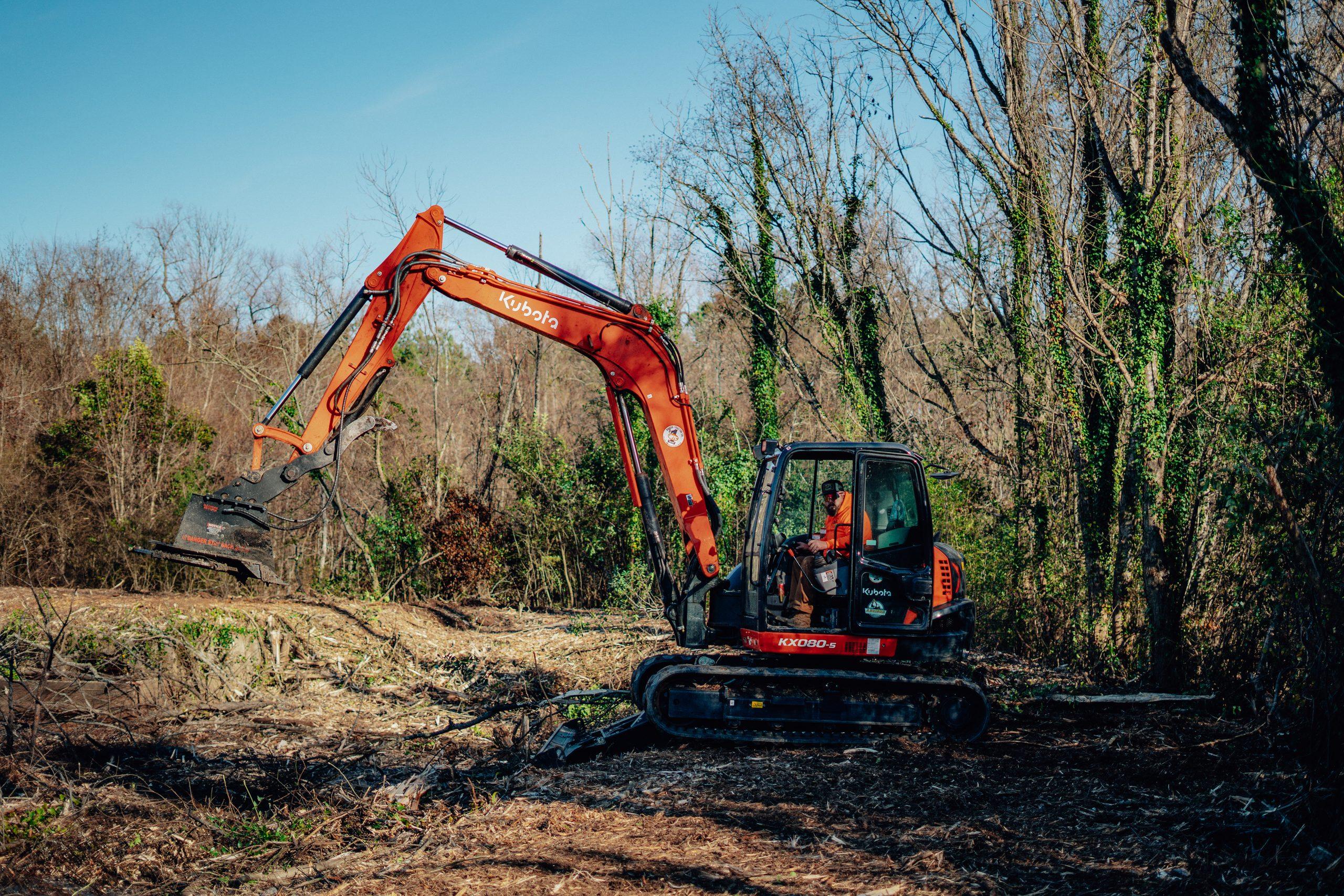
A forestry mulcher is a purpose-built machine - usually a skid steer or dedicated carrier with a high-flow mulching head - that shreds standing vegetation into chips and drops them on the ground as it goes. One machine, one operator, one pass.
What that means on the ground:
- Trees come down and become mulch in the same motion - typically up to 6-8 inch diameter material handled continuously, with larger trees possible depending on the head.
- No debris piles. What was standing brush at 8 AM is a layer of shredded mulch by lunch.
- Minimal soil disturbance. The machine's weight is spread on tracks, and because nothing gets pushed and piled, the topsoil stays where it is.
- Instant erosion protection. The mulch layer covers bare soil the moment it's created - a meaningful advantage on sloped Hall County terrain.
Compare that to a dozer-and-pile operation: push everything into windrows, burn or haul the piles, then fix the ruts and stripped topsoil the dozer left behind. For a detailed look at the broader clearing decision, our land clearing best practices post covers the full menu.
When Forestry Mulching Is the Right Call
Mulching earns its keep on specific job types around Gainesville:
- Underbrush and overgrowth: Reclaiming pasture edges, opening up wooded lots, clearing fence lines - mulching handles thick brush faster than any other method.
- Selective clearing: Want the hardwoods kept and the understory gone? A mulcher works around trees you want to save instead of bulldozing everything.
- Trails and access corridors: Cutting shooting lanes, ATV trails, or access paths through woods without building a real road.
- View and lake-lot clearing: Opening sight lines toward Lake Lanier or a mountain view while keeping the ground intact and looking natural.
- Erosion-sensitive sites: Steep slopes, creek buffers, and anywhere stripped soil would be a problem.
The finished product looks maintained, not bulldozed - a park-like understory with a carpet of chips that breaks down into soil within a season or two.
When Mulching Alone Won't Get It Done
Mulching has real limits, and a contractor who says otherwise is selling:
- Stumps stay in the ground. Mulching takes trees off at ground level - the root ball stays. If you're building, putting in a septic field, or grading a yard, stumps have to be dug out anyway.
- Large timber is slow or impossible. Beyond the head's capacity, big hardwoods need a saw or an excavator, not more mulcher hours.
- It doesn't change the grade. Mulching clears vegetation; it doesn't move dirt. Any reshaping needs grading equipment.
- Regrowth happens. Some species resprout from the roots. Without follow-up, a mulched understory can grow back thicker than it started.
The common pattern on build sites: mulch the understory first for access and visibility, then bring in the excavator for the stumps and grading inside the building envelope. Done in that order, each method does what it's best at.
What Forestry Mulching Costs Around Gainesville
Mulching is typically priced by the day or by the acre, and the honest answer on cost is that it depends on density. An hour of mulching in light briars covers ten times the ground of an hour in head-high hardwood saplings.
The factors that drive the number:
- Density and diameter of material - brush versus standing timber is the biggest variable.
- Terrain - slopes slow everything down and wear the machine harder.
- Access - how far the machine has to travel, and whether the site needs a mat path in wet ground.
- Finish expectations - a rough fuel-reduction pass versus a manicured park-like finish are different amounts of time on the same acreage.
As a rule of thumb, mulching beats dozing on cost when the material is light-to-medium and the goal is clearing rather than reshaping. Once stumps need to come out or dirt needs to move, an excavator earns its seat. Most Hall County projects end up using both.
Forestry Mulching Around Gainesville and Hall County
Addison Excavations provides forestry mulching and land clearing throughout the Gainesville area - from the lake communities along Lanier to the farm and acreage properties toward Murrayville, Lula, and North Hall.
Because we're a full-service excavation company, mulching isn't a dead-end service with us: if the job grows into stump removal, grading, drainage, or site prep, it's the same crew and the same mobilization. See the full scope on our land clearing services page or our Gainesville coverage page.
The first step is a walk of the property - density and terrain set the price, and neither one photographs well enough to quote from a driveway.
See Your Land Again
Forestry mulching reclaims overgrown property in days, not weeks - no burn piles, no hauling, no stripped soil. Addison Excavations mulches and clears across Hall County.