Land Clearing Services in Cumming, GA: From Wooded Lot to Build-Ready Site
The Short Version
Forsyth County is one of the fastest-growing counties in Georgia, and most of that growth is happening on wooded acreage - the infill lots, family land splits, and rural parcels around Cumming that are turning into homesites. Between buying the lot and pouring the foundation sits a step that decides how the whole project goes: clearing it properly. Land clearing sounds simple - take the trees out. In practice it's a sequence of decisions with regulatory and cost consequences: what stays and what goes, how the debris gets handled, where the erosion controls go, and how the cleared ground transitions into the grading phase without losing a month to rework. Here's what professional land clearing looks like on a Cumming-area project, what Forsyth County expects, and how to think about the order of operations.
What Land Clearing Actually Includes
A clearing scope on a Cumming homesite typically covers more than people expect:
- Tree and brush removal: Taking down standing timber and clearing undergrowth across the building envelope, driveway corridor, and any yard areas.
- Stump removal: Digging stumps out - not grinding them flush, and definitely not burying them. Buried stumps are the classic cause of settled foundations and cracked driveways a few years after the build.
- Debris handling: Grinding, hauling, burning where permitted, or mulching in place - each with different cost and site-impact trade-offs.
- Erosion control installation: Perimeter sediment control and a stabilized construction entrance, installed before or as clearing begins.
- Rough grading transition: Leaving the site shaped and ready for the next phase instead of a stump-hole moonscape that needs a second mobilization.
That last point is where hiring an excavation contractor instead of a tree-only crew pays for itself - the clearing and the grading are one continuous operation, not two contractors pointing at each other.
Clearing Methods: Mulch, Push, or Cut-and-Haul
How the vegetation comes off the land matters for both cost and what the site looks like afterward:
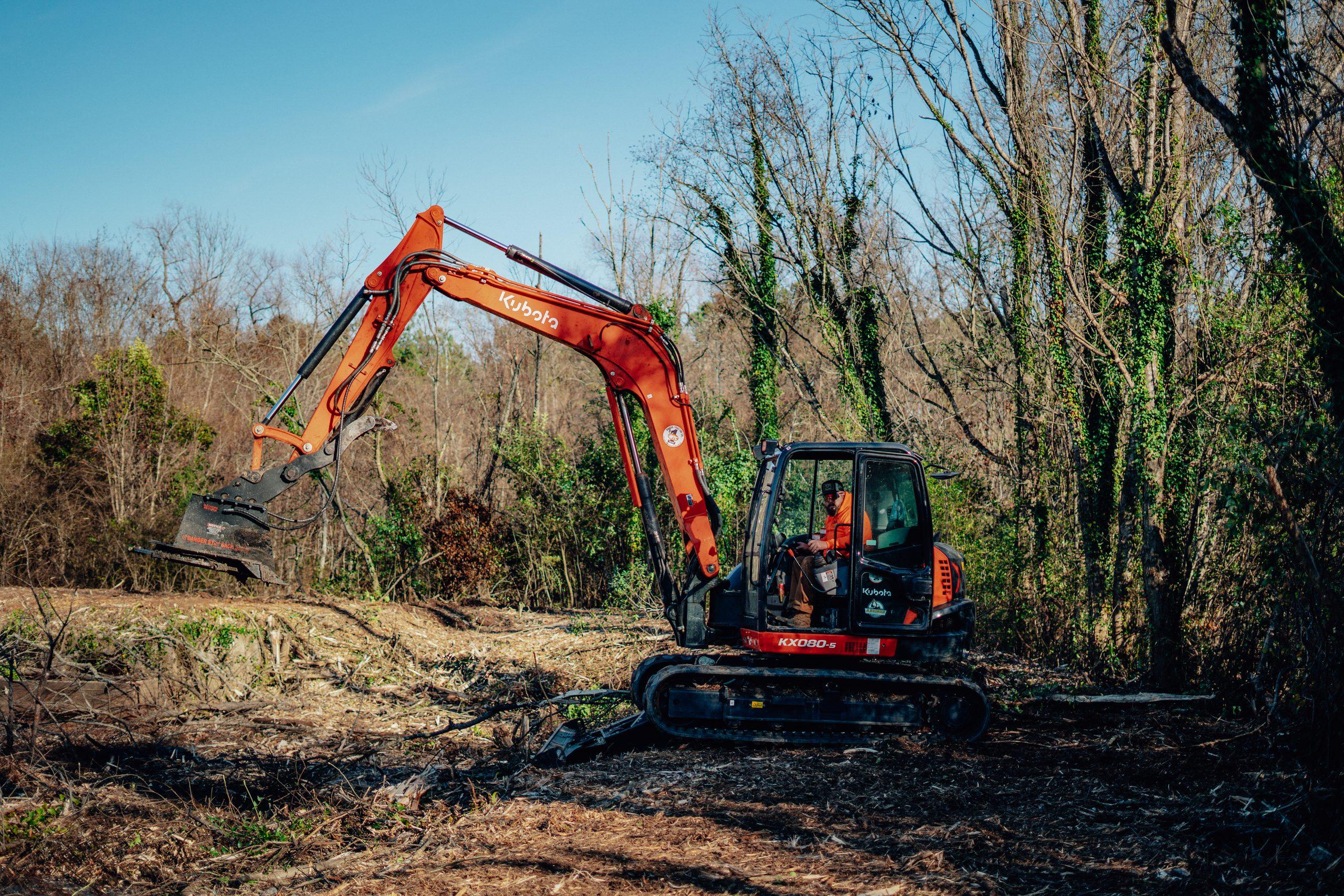
- Forestry mulching: A mulching head shreds brush and smaller trees in place, leaving a layer of chips on intact topsoil. Fast, clean, no debris piles - ideal for undergrowth, selective clearing, and erosion-sensitive ground. The limitation: stumps and large timber stay, so it's not a complete answer where you're building.
- Dozer clearing: Pushing trees and stumps into piles for burning or grinding. Fast on heavy timber, but it disturbs topsoil and creates the debris problem that has to be solved next.
- Cut-and-haul: Felling and removing material off-site. Cleaner finish, more truck trips, higher cost - usually reserved for valuable timber or tight lots with no room to pile.
Most Cumming-area projects blend methods: mulch the understory for access and erosion protection, then excavate the stumps and larger trees inside the building envelope. Our forestry mulching guide covers where that method shines.
What Forsyth County Expects Before You Clear
Clearing isn't a free-for-all - Forsyth County has land-disturbance rules, and Georgia's erosion control requirements sit on top of them:
- Land-disturbance permits: Clearing tied to construction typically runs through the county's permitting process. Thresholds and specifics are covered in our Forsyth County land-disturbance permit guide.
- Erosion and sediment control: Disturbed soil needs perimeter control before it can reach a ditch, storm drain, or neighbor. On anything approaching an acre, formal BMP requirements apply.
- Stream buffers: Work near perennial streams falls under state buffer rules - clearing to the creek bank is a violation waiting to happen.
- Burn restrictions: Open burning on-site requires adherence to Georgia Forestry Commission rules and seasonal bans - one more reason mulching has become the default for lighter material.
None of this is complicated, but all of it is easier to satisfy when the clearing contractor plans it into the job rather than improvising after the inspector calls.
Sequencing Clearing with Your Build
The cheapest clearing is the clearing done once. The expensive version is clearing a lot, discovering the septic field needs to move, and paying to clear a second area - or worse, clearing everything and paying to re-stabilize land that didn't need disturbing.
A sequencing that avoids rework:
- Site evaluation first: House location, septic field, well, driveway route, and drainage plan decided before any trees come down.
- Mark the envelope: Clear only what's needed - the building pad, drive corridor, septic area, and defensible yard space. The rest can stay wooded and free.
- Clear and mulch the understory: Open access without stripping soil.
- Stump and rough grade: Excavate stumps in the envelope and shape the site in the same mobilization.
- Stabilize immediately: Straw, matting, or mulch on any soil that's going to sit - bare red clay through one storm season is a drainage repair job.
For the full grading scope that follows clearing, our grading services page covers what comes next.
Land Clearing Around Cumming and Forsyth County
Addison Excavations clears residential lots, acreage, and commercial pads across Forsyth County - Cumming, Coal Mountain, the GA-400 corridor, and the rural properties toward the Cherokee and Dawson county lines.
Because clearing almost always leads somewhere - a homesite, a pond, a driveway, a pasture - we scope it as the first phase of the actual project, not a standalone service. Our land clearing services page has the full capability list, and our project gallery shows recent clearing and site-prep work.
If you're pricing a Cumming-area lot, walk it with a clearing contractor before you close - the tree density and terrain are the difference between a straightforward job and a surprise.
Clear It Once, Clear It Right
The difference between a cleared lot and a build-ready site is the plan behind it. Addison Excavations clears and preps Forsyth County properties from first tree to finish grade.